
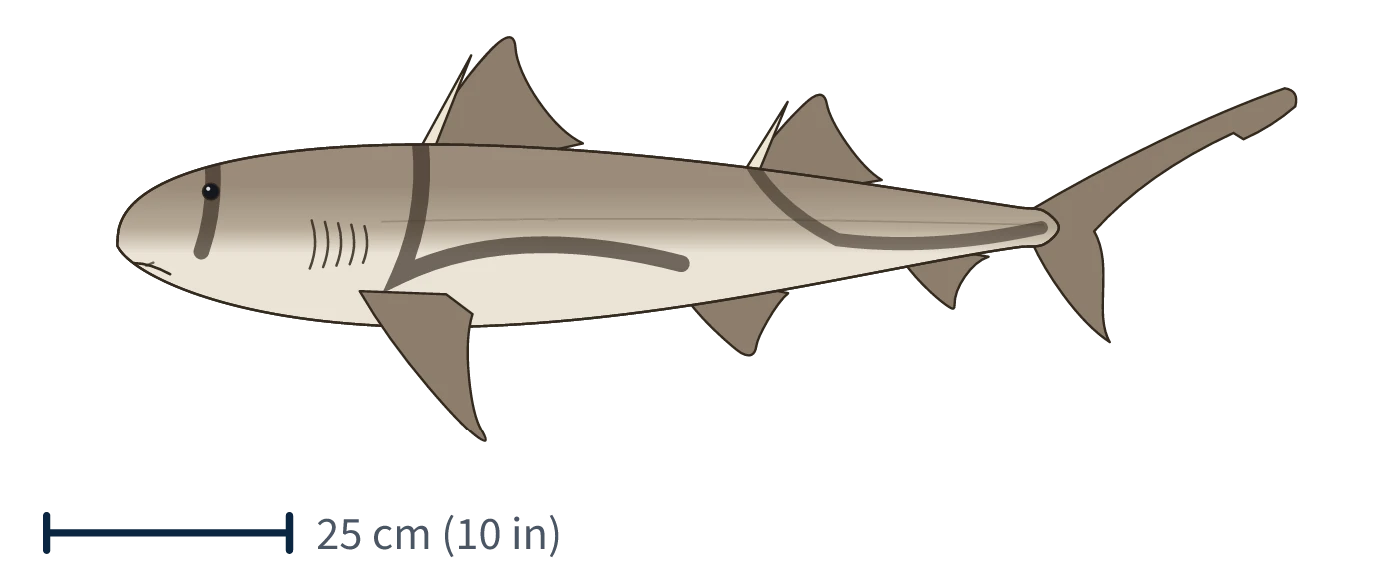
Quick facts
- Size
- Up to about 5.4 ft (1.65 m)
- Range
- Southern Australia
- Habitat
- Rocky reefs and nearby sand to about 275 m (900 ft)
- Diet
- Sea urchins, mollusks, crabs and small fishes
- Young
- Egg layer; 10 to 16 spiral egg cases a year
- Red List class
- Least Concern
- Order
- Bullhead sharks (Heterodontiformes)
- Family
- Heterodontidae
- Scientific name
- Heterodontus portusjacksoni
About the Port Jackson shark
Ridges over the eyes, a pig-like snout and a dark harness across the back make this shark easy to recognize. Small pointed teeth at the front of the mouth grip prey, and broad flat teeth at the back crush shells. It can pump water over its gills while eating. Each winter adults return to the same reefs to breed, some after journeys of hundreds of kilometers.
The Port Jackson shark belongs to the bullhead sharks, one of the nine living orders of sharks. All About Sharks tells the story of sharks as a whole and names the 39 that have a page here.
More about the Port Jackson shark
The tendrils snag on seaweed and hold the case in place. Bullhead sharks, such as the Port Jackson shark, make a spiral case like the tip of a drill, which the mother carries in her mouth and wedges into a crevice in the rock.
Many reef and coastal species are most active at dusk, during the night and at dawn, when the low light favors a hunter with sensitive eyes. By day they rest: nurse sharks in heaps under ledges, whitetip reef sharks in caves, Port Jackson sharks in gullies, each often returning to the same spot for years.
Given a choice, they prefer to swim with sharks of their own size and with individuals they already know. Port Jackson sharks in Australia also have preferred companions, and seek them out again each breeding season.
In laboratory tests young lemon sharks, bamboo sharks and Port Jackson sharks have learned to press targets, find their way through mazes and tell shapes apart, and they remember the lessons for months. In one study Port Jackson sharks learned to swim to a particular corner of a tank for food when jazz was played through an underwater speaker.
More sharks
 Whale sharkRhincodon typusEndangered
 AngelsharkSquatina squatinaCritically Endangered
 Nurse sharkGinglymostoma cirratumVulnerable
 Longnose sawsharkPristiophorus cirratusLeast Concern
PreviousAngelsharkAll About SharksAll 39 speciesNextWhale shark
FAQs about the Port Jackson Shark
6 Questions
How big is the Port Jackson shark?
Up to about 5.4 ft (1.65 m).
Where does the Port Jackson shark live?
Southern Australia. Habitat: rocky reefs and nearby sand to about 275 m (900 ft).
What does the Port Jackson shark eat?
Sea urchins, mollusks, crabs and small fishes.
How does the Port Jackson shark reproduce?
Egg layer; 10 to 16 spiral egg cases a year.
Is the Port Jackson shark threatened with extinction?
No. The Port Jackson shark is classed as Least Concern on the IUCN Red List, which means it is widespread and not at significant risk at present. Regional populations may differ, and classes are revised from time to time.
What kind of shark is the Port Jackson shark?
The Port Jackson shark (Heterodontus portusjacksoni) belongs to the family Heterodontidae in the order Heterodontiformes, the bullhead sharks. That is one of the nine living orders of sharks.
General Knowledge
GK4 Yearbook India GK for all competitive exams
World Encyclopedia
GK4 Encyclopedia World GK

We Value Your Opinion Comments