

Shark Video
Shark Profile
- Kind
- Fish with a skeleton of cartilage, not bone
- Class
- Chondrichthyes, the cartilaginous fishes
- Relatives
- Rays and skates are the closest
- Species
- 565 alive today, in 9 orders and 38 families
- Appeared
- About 450 million years ago, before the first forests
- Size
- From about 8 in (20 cm) in the dwarf lanternshark to 61.7 ft (18.8 m) in the whale shark
- Lifespan
- From about 7 years in the Australian sharpnose shark to at least 272 in the Greenland shark
- Teeth
- Set in rows and replaced for life
- Diet
- Mostly fish, squid, crabs and shellfish. Three giants strain plankton
- Habitat
- Every ocean, from the shoreline to the deep sea. A few live in rivers
- Young
- About four in ten species lay eggs. The rest bear live young
- Gestation
- From 4.5 to 5 months in the bonnethead to 2 years in the spiny dogfish, and an estimated 3.5 in the frilled shark
- Litter size
- From 1 pup in the gulper shark to about 300 in one whale shark
Sharks at a Glance
Eight records of the shark world, each with the animal and the place behind the number.
Older Than Trees
Sharks were hunting the seas before the first forests grew on land. In the 450 million years since, they have come through five mass extinctions and outlived the giant sea reptiles.
The shark most people picture, a gray torpedo with a mouthful of knives, is only one kind among 565. There are flat sharks that lie buried in sand, sharks with saws for snouts, sharks that glow and sharks that walk across reef flats on their fins. About half of all species never grow longer than 3.3 ft (1 m), and the biggest shark of all strains plankton from the sea.
A skeleton of cartilage rots before it can turn to stone, so whole fossil sharks are rare. Their teeth make up for it. A shark sheds teeth all its life, and shark teeth are among the most common fossils of any animal with a backbone.

Sharks are nearly twice as old as the earliest dinosaurs.
What Makes a Shark a Shark
A shark is a fish. It lives in water, breathes with gills and steers with fins. Five features set it apart from the bony fishes around it.
A skeleton without bone
Skull, jaws and spine are cartilage, the firm, flexible stuff of your nose and ears. It is about half as dense as bone, so it saves weight.
Open gill slits
Five slits on each side of the head, six or seven in a few old families, open straight to the sea. Bony fishes hide theirs under a hard flap.
Skin made of teeth
Every scale is built like a tiny tooth. Stroke a shark from head to tail and it feels smooth. Stroke it the other way and it rasps like sandpaper.
Teeth on a conveyor
Teeth form in rows and move forward as the front ones fall out. A large shark can get through tens of thousands in a lifetime.
No swim bladder
Sharks stay up with a huge liver full of light oil and with lift from their fins. In a basking shark the liver can be a quarter of the animal’s weight.

Rays share all five features. A ray is, in effect, a shark that took to the seabed: its body flattened and its gill slits moved to the underside. A manta ray is a closer relative of the great white shark than either is to a salmon.

Super Senses
Light fades fast under water, so a shark does not rely on its eyes alone. It hears, smells, feels the water move and senses electricity, and each sense takes over where the last one ends.
Hearing
Often the first alert. Sharks hear low sounds best, such as a struggling fish, and have swum toward underwater speakers from hundreds of meters away.
Smell
A shark follows a scent up the current and turns toward whichever nostril catches it first, even by a fraction of a second.
Sight
A layer of mirror crystals behind the retina sends light through the eye a second time. The same layer makes a cat’s eyes shine.
Water movement
Canals under the skin, the lateral line, feel currents and the wake of a fish swimming a body length or two away.
Electricity
Jelly filled pores on the snout pick up the weak electric field of a living animal. A shark can find a flatfish buried under sand.
Magnetism
Young bonnethead sharks in a test tank behaved as if they read their position from the magnetic field of the Earth and set a course for home.
A shark can feel an electric field of 5 billionths of a volt per centimeter. A flashlight battery with its ends 3,000 km (1,900 miles) apart in the sea makes about that much.


Meet 12 Famous Sharks
These twelve are the sharks people know best. Each has a page of its own, with its size, range, food and young.

Great white shark
Carcharodon carchariasThe best known shark of all. It strikes seals from below so fast that it can leave the water. Nobody has ever seen one mate or give birth.
Up to about 20 ft (6 m) · Vulnerable
Meet the great white shark
Whale shark
Rhincodon typusA giant that swims open mouthed through clouds of plankton. The pattern of pale spots behind its gills is unique to each animal.
Up to 61.7 ft (18.8 m) · Endangered
Meet the whale shark
Tiger shark
Galeocerdo cuvierBroad jaws and saw edged teeth cut through turtle shell. Stomachs have also held license plates and tins. Its dark bars fade with age.
Up to about 18 ft (5.5 m) · Near Threatened
Meet the tiger shark
Bull shark
Carcharhinus leucasA heavy, blunt snouted shark that lives in the sea and in fresh water alike. It has been found about 4,000 km (2,500 miles) up the Amazon.
Up to about 11 ft (3.4 m) · Vulnerable
Meet the bull shark
Great hammerhead
Sphyrna mokarranThe largest of about ten hammerheads. Its wide head spreads the eyes, nostrils and electric sensors, and pins stingrays to the seabed.
Up to about 20 ft (6 m) · Critically Endangered
Meet the great hammerhead
Shortfin mako
Isurus oxyrinchusBuilt like a tuna, with a crescent tail and warm swimming muscles, and known for spectacular leaps. Nobody has yet clocked its top speed.
Up to about 13 ft (4 m) · Endangered
Meet the shortfin mako
Greenland shark
Somniosus microcephalusIt swims slowly through Arctic water close to freezing and lives at least 272 years. Females do not breed until about 150.
Up to at least 21 ft (6.4 m) · Vulnerable
Meet the Greenland shark
Basking shark
Cetorhinus maximusIt cruises under the surface with its mouth open about 3 ft (1 m) wide, combing plankton from the water. Tags have shown it crossing oceans.
Up to about 40 ft (12 m) · Endangered
Meet the basking shark
Goblin shark
Mitsukurina owstoniA soft, pink shark of deep water with a long blade of a snout. Its jaws shoot forward by almost a tenth of its body length to snatch prey.
Up to at least 12.5 ft (3.8 m) · Least Concern
Meet the goblin shark
Nurse shark
Ginglymostoma cirratumA slow bottom dweller that spends the day piled with others under ledges. At night it sucks prey from crevices, and even a conch from its shell.
Up to about 10 ft (3 m) · Vulnerable
Meet the nurse shark
Pelagic thresher
Alopias pelagicusNearly half its length is tail. It whips the tail overhead into schools of fish, the tip moving at about 50 km/h (30 mph), and stuns several at a stroke.
Up to about 11.5 ft (3.5 m) · Endangered
Meet the pelagic thresher
Blue shark
Prionace glaucaSlender, long finned and indigo above, it crosses the Atlantic on the great currents. It is also the most heavily fished shark in the world.
Up to about 12.5 ft (3.8 m) · Near Threatened
Meet the blue sharkThe Nine Orders of Sharks
Scientists sort the 565 species into nine orders. Count the fins and the gill slits, look at the mouth, and you can place almost any shark. The sharks named here have pages of their own.
Cow and frilled sharks
7 speciesHexanchiformes
Six or seven gill slits and a single dorsal fin. The oldest living order, about 195 million years old.
Bramble sharks
2 speciesEchinorhiniformes
Thorny skin and no anal fin. Large, slow sharks of deep water.
MeetBramble shark
Dogfish sharks
144 speciesSqualiformes
No anal fin, often a spine on each dorsal fin. Many make their own light.
MeetSpiny dogfish, Greenland shark, Cookiecutter shark, Velvet belly lanternshark, Dwarf lanternshark
Sawsharks
10 speciesPristiophoriformes
A long, flat snout edged with teeth, with a pair of barbels on it.
Angelsharks
26 speciesSquatiniformes
Flat like rays. They lie buried in sand and strike upward.
MeetAngelshark
Bullhead sharks
10 speciesHeterodontiformes
A blunt head, a spine on each dorsal fin and back teeth that crush shells.
Carpet sharks
45 speciesOrectolobiformes
Mouth in front of the eyes, with barbels. Most live in warm shallows. The whale shark is the great exception.
MeetWhale shark, Nurse shark, Tasselled wobbegong, Epaulette shark, Zebra shark
Mackerel sharks
15 speciesLamniformes
No third eyelid. Several keep their bodies warm, and two of the three plankton eaters belong here.
MeetGreat white shark, Shortfin mako, Porbeagle, Salmon shark, Basking shark, Pelagic thresher, Sand tiger shark, Goblin shark, Megamouth shark, Megalodon (extinct)
Ground sharks
306 speciesCarcharhiniformes
A third eyelid that can cover the eye. More than half of all sharks, from small catsharks to tiger sharks.
MeetTiger shark, Bull shark, Speartooth shark, Blue shark, Oceanic whitetip shark, Great hammerhead, Scalloped hammerhead, Bonnethead, Blacktip reef shark, Lemon shark, Small-spotted catshark, Tope shark, Gray reef shark
What’s in a Name?
A shark has two kinds of name. Its common name changes from one coast to the next. Its scientific name, in two parts, is the same in every language: the great white shark is Carcharodon carcharias, from Greek words for jagged tooth and for shark.
Names that mislead
| Name | What it really is |
|---|---|
| Whale shark | A shark, and the largest fish alive. It breathes with gills, as every fish does. See the whale shark. |
| Great white shark | Scientists call it the white shark, because there is no lesser white shark. Both names are correct. See the great white shark. |
| Sand tiger, grey nurse, ragged-tooth | One species with three names, in the United States, Australia and South Africa. It is neither a tiger shark nor a nurse shark. See the sand tiger shark. |
| Leopard shark | In much of Asia and Australia, the zebra shark. In California, a different small shark, Triakis semifasciata. |
| Sawshark and sawfish | A sawshark is a shark, with gill slits on its sides and barbels on its saw. A sawfish is a ray, with gill slits underneath. |
| Dogfish | Any of dozens of small sharks from several families. See the spiny dogfish. |
| Ghost shark | Not a shark. It is a chimaera, a distant cousin with one gill opening on each side. |
| Bala shark, rainbow shark | Not sharks at all. They are freshwater bony fishes of the carp family. |
How Sharks Live
Sharks grow slowly, breed late and raise few young. It served them well for 450 million years.
Eggs in a case
About four in ten species lay eggs in tough cases and leave them. The young live on the yolk for months.
Catsharks such as the small-spotted catshark, bullhead sharks such as the Port Jackson shark, the zebra shark.
Live birth on yolk
The eggs hatch inside the mother, and the young live on their yolk until they are born.
The spiny dogfish, the whale shark, the tiger shark.
Live birth on eggs
When the yolk runs out the mother keeps making eggs and the young eat them. Sand tiger young also eat each other, so only two are born.
The great white shark, the makos, the threshers, the sand tiger shark.
Live birth with a placenta
A cord carries food from the mother’s blood to each pup, much as in mammals.
The bull shark, the blue shark, the lemon shark, the hammerheads.
Slow to grow up
A female great white shark in the North Atlantic is about 33 before she first breeds, and the oldest great white on record, a male, was 73. A Greenland shark waits about 150 years. Many sharks give birth only every second or third year, so their numbers grow by only a few percent a year. No shark is known to look after its young.
What is on the menu
Fish is the staple, with squid, crabs and shellfish. Only a handful of big sharks kill seals or dolphins. The whale shark, the basking shark and the megamouth shark eat some of the smallest animals in the sea. The bonnethead digests the seagrass it swallows, and the cookiecutter shark twists round plugs of flesh out of tuna, dolphins and whales.
Ocean travelers
Tags show sharks crossing whole oceans and coming back. A great white shark named Nicole swam from South Africa to Western Australia and back, about 20,000 km (12,400 miles), in under nine months. A basking shark crossed the Atlantic from the Isle of Man, in the British Isles, to Newfoundland, Canada, in 82 days.

The lives of seven sharks
| Shark | Females first breed | Oldest on record | Pregnancy | Young in a litter |
|---|---|---|---|---|
| Blue shark | About 5 to 6 years | About 20 years | 9 to 12 months | About 35 on average |
| Shortfin mako | About 18 years | 32 years | 15 to 18 months | About 11 on average |
| Spiny dogfish | About 12 years | 40 years | 18 to 24 months | 2 to 15, on average 6 |
| Sand tiger shark | About 9 to 10 years | About 40 years | 9 to 12 months | 2 |
| Great white shark | About 33 years | 73 years | Not known. Estimates exceed one year | 2 to 10 or more |
| Greenland shark | About 150 years | At least 272 years | Not known | Not known. One report gives about 10 |
| Whale shark | Not known. Estimates start at 25 years | Not known | Not known | About 300 in the one female examined |
The figures for the shortfin mako, the spiny dogfish and the great white shark are for the North Atlantic. Values differ from one region to the next.
Sharks and People
People are not natural prey for any shark. The danger runs the other way.
The International Shark Attack File, kept at the Florida Museum of Natural History, confirms about 60 to 70 unprovoked bites worldwide in a typical year. On average fewer than ten are fatal. About 300,000 people drown every year.
Most bites are one quick bite in murky water, after which the shark lets go. The leading explanation is a mistake by a shark that was hunting fish. Three large species, the great white shark, the tiger shark and the bull shark, account for most of the serious ones.
Fishing kills about 80 million sharks a year. About a third of all sharks, rays and chimaeras are threatened with extinction, and overfishing threatens every one of those species. The sharks and rays of the open ocean have fallen by 71 percent since 1970.
Protection works when it is given time. Palau, an island nation in the western Pacific, closed all of its waters to commercial shark fishing in 2009, and 16 more countries and territories followed within ten years. Great white sharks off the east coast of the United States, protected since 1997, are increasing again.
For every person killed by a shark, fishing kills millions of sharks.
Shark Myths and the Truth
Few animals carry as many myths as sharks. Here are eight you will hear, and what the evidence says.
- MythSharks are man eaters.
- TruthNo shark hunts people as prey. Most bites are a single quick bite, and the shark lets go and leaves.
- MythA shark that stops swimming dies.
- TruthTrue for a few dozen species, among them the great white shark, the makos and the whale shark. Most sharks can pump water over their gills, and many spend much of their lives lying still on the seabed.
- MythSharks smell a drop of blood from miles away.
- TruthA scent travels only where the current carries it. In careful tests the sharpest noses reacted to about one part in a billion, which is like one drop in a backyard swimming pool. Other fishes do about as well.
- MythSharks do not get cancer.
- TruthThey do. Tumors are on record in dozens of species of sharks and rays, the great white shark among them. Trials found that shark cartilage pills do nothing for patients.
- MythMegalodon still lives in the deep sea.
- TruthIts youngest fossils are about 3.6 million years old. A whale hunter that size would leave fresh teeth and bitten carcasses, and none has been found. The deep sea is cold and holds too little food for it.
- MythAll sharks are big and dangerous.
- TruthAbout half of all species are under 3.3 ft (1 m) long. About a dozen of the 565 are known to have killed a person.
- MythSharks never sleep.
- TruthDraughtsboard sharks, small bottom dwellers of New Zealand, have been shown to sleep, often with their eyes open. How sharks that never stop swimming rest is still unknown.
- MythThe mako swims at 70 km/h (43 mph).
- TruthNobody has measured its top speed. The fastest burst a tag has recorded on a free swimming mako is about 18 km/h (11 mph). The true figure is higher, and still unknown.
A Shark Timeline
Thirteen moments, from the first scales in the rock to the strictest trade rules.
- About 450 million years ago
The first traces
Rocks of this age hold tiny scales that look like the scales of sharks. Experts still argue over the fish that wore them. No forest has yet grown on land.
- About 380 million years ago
Cladoselache
A streamlined hunter up to about 6.5 ft (2 m) long swims over what is now Cleveland, Ohio. Some of its fossils still hold fish that it swallowed tail first.
- About 195 million years ago
The oldest living order
The cow sharks appear. Frilled sharks and sixgill sharks, their relatives, still swim today.
- About 3.6 million years ago
The largest shark known disappears as the seas cool and the small whales it hunted grow scarce.
- 1667
Tongue stones explained
The Danish anatomist Nicolas Steno shows that the “tongue stones” of Mediterranean islands are the teeth of sharks. His work helps to found geology.
- 1678
The electric pores
The Italian anatomist Stefano Lorenzini describes the jelly filled pores on a shark’s snout. Nobody learns what they are for until the 1960s.
- 1916
The New Jersey attacks
Four people are killed along the coast of New Jersey in July, two of them in a tidal creek. The headlines start the modern fear of sharks.
- 1975
Jaws
The film of Peter Benchley’s novel makes the shark a screen monster. Benchley spends much of his later life campaigning for shark conservation.
- 1976
The megamouth
A large shark unknown to science tangles in the sea anchor of a United States Navy ship off Hawaii. It is named the megamouth.
- 2001
Virgin birth
A bonnethead in a Nebraska zoo gives birth to a pup that has no father.
- 2009
The first shark sanctuary
Palau, in the western Pacific, closes all of its waters to commercial shark fishing.
- 2016
The oldest of all
Dating of the eye lens shows that the Greenland shark lives at least 272 years, longer than any other animal with a backbone.
- 2025
The strictest trade rules
The whale shark and the oceanic whitetip shark are given the highest level of protection from international trade.
Shark Pictures
Real-Life Pictures and Realistic Watercolor Images
156 Pictures
 Zebra Shark PictureLike0 likes
 Zebra Shark PictureLike0 likes
 Zebra Shark PictureLike0 likes
 Wobbegong Shark Watercolor PictureLike0 likes
 Whitetip Reef Shark Watercolor PictureLike0 likes
 White Tip Reef Shark PictureLike1 like
 Whale Shark PictureLike0 likes
 Whale Shark PictureLike0 likes
 Whale Shark PictureLike0 likes
 Whale Shark PictureLike1 likeWhale Shark PictureLike0 likes
 Tiger Shark Watercolor PictureLike0 likes
 Tiger Shark PictureLike0 likes
 Tiger Shark PictureLike0 likesTiger Shark PictureLike0 likes
 Thresher Shark Watercolor PictureLike0 likes
 Spotted Dogfish Shark Watercolor PictureLike0 likes
 Spiny Dogfish Shark Watercolor PictureLike0 likes
 Speartooth Shark Watercolor PictureLike0 likes
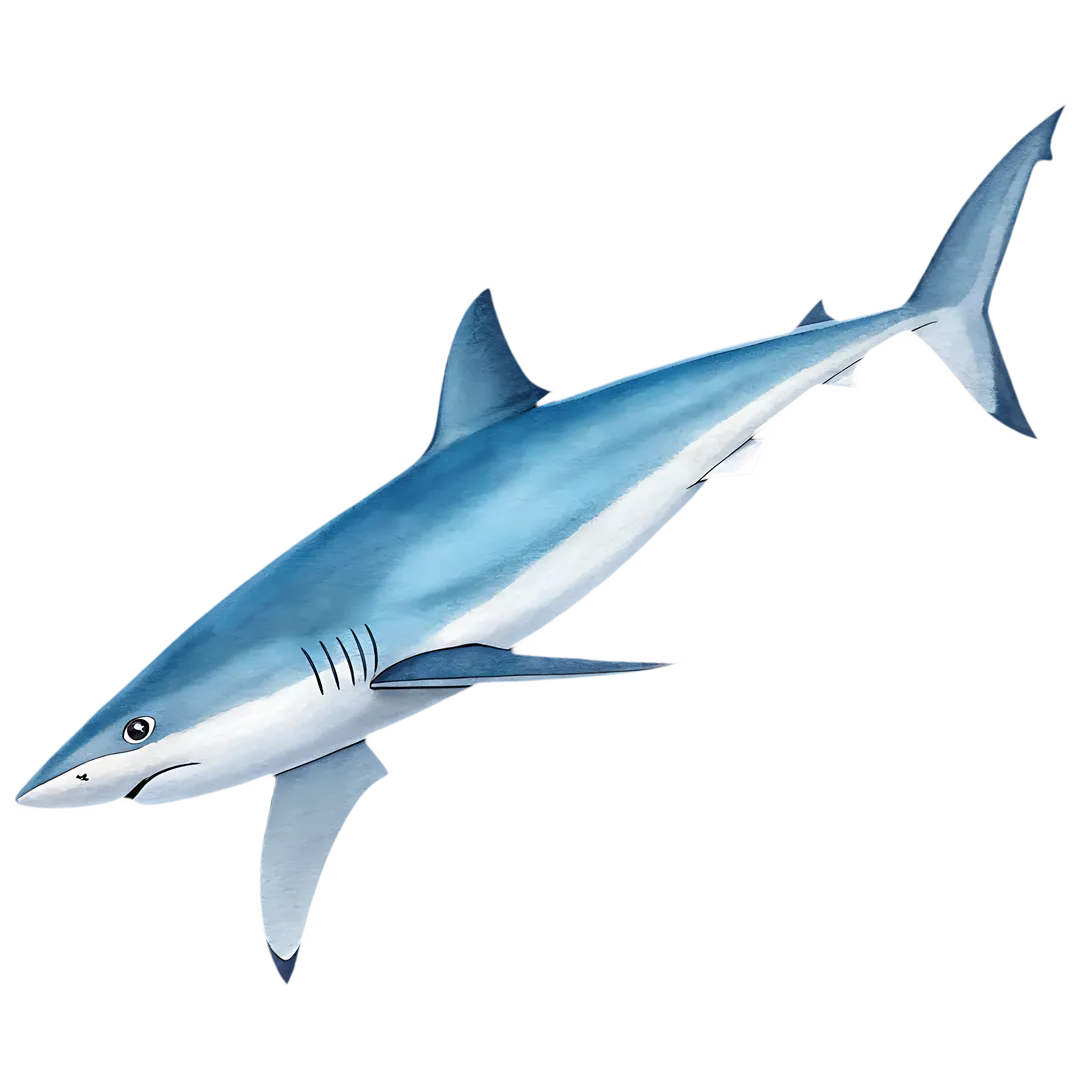 Silky Shark Watercolor PictureLike0 likes
 Silky Shark PictureLike0 likes
 Shortfin Mako Shark Watercolor PictureLike0 likes
 Shortfin Mako Shark PictureLike0 likes
 Shortfin Mako Shark PictureLike0 likesShortfin Mako Shark PictureLike0 likes
 Shark Watercolor PictureLike0 likes
 Shark Watercolor PictureLike0 likes
 Shark Watercolor PictureLike0 likes
 Shark Watercolor PictureLike0 likes
 Shark Watercolor PictureLike0 likes
 Shark Watercolor PictureLike0 likes
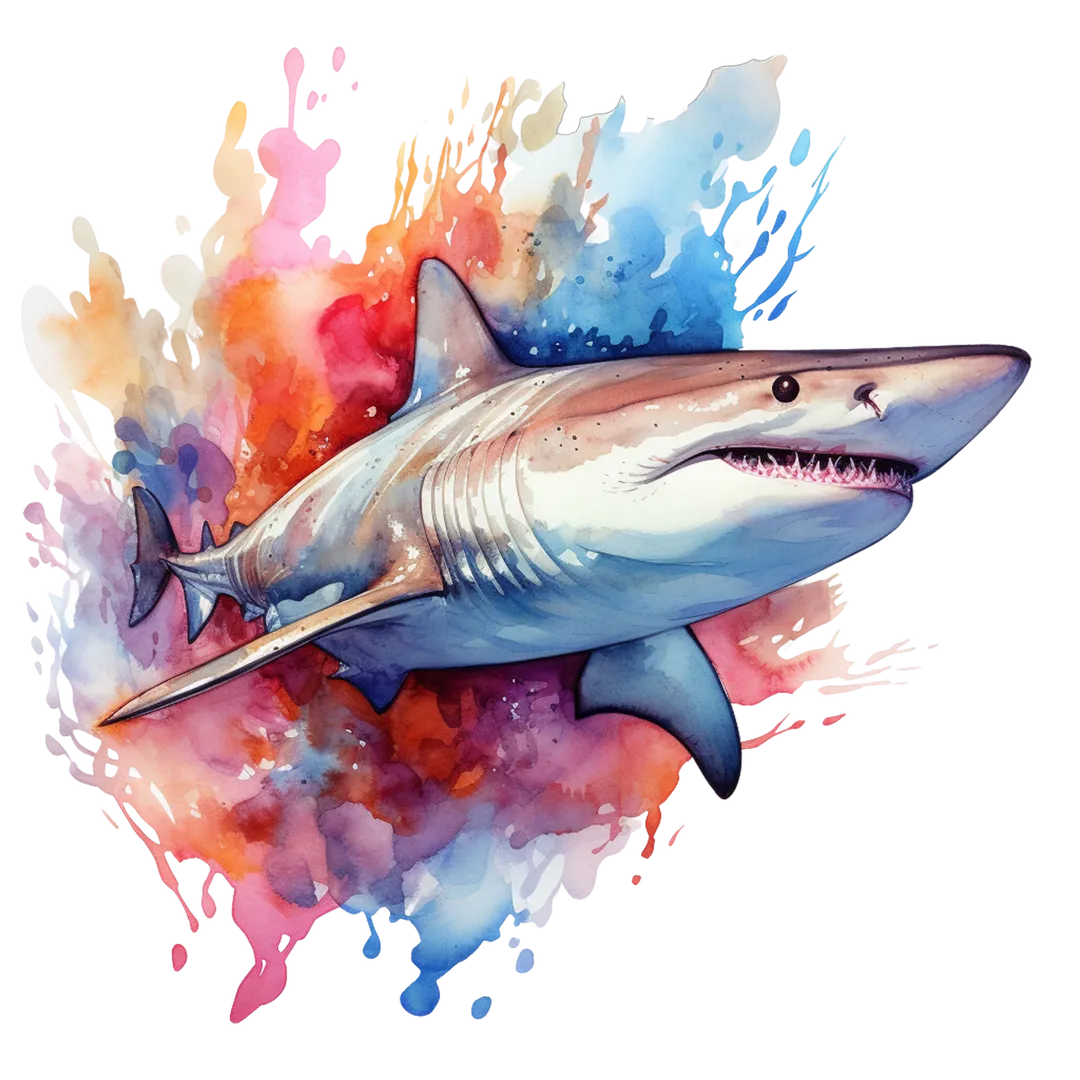 Shark Watercolor PictureLike0 likes
 Shark Watercolor PictureLike0 likes
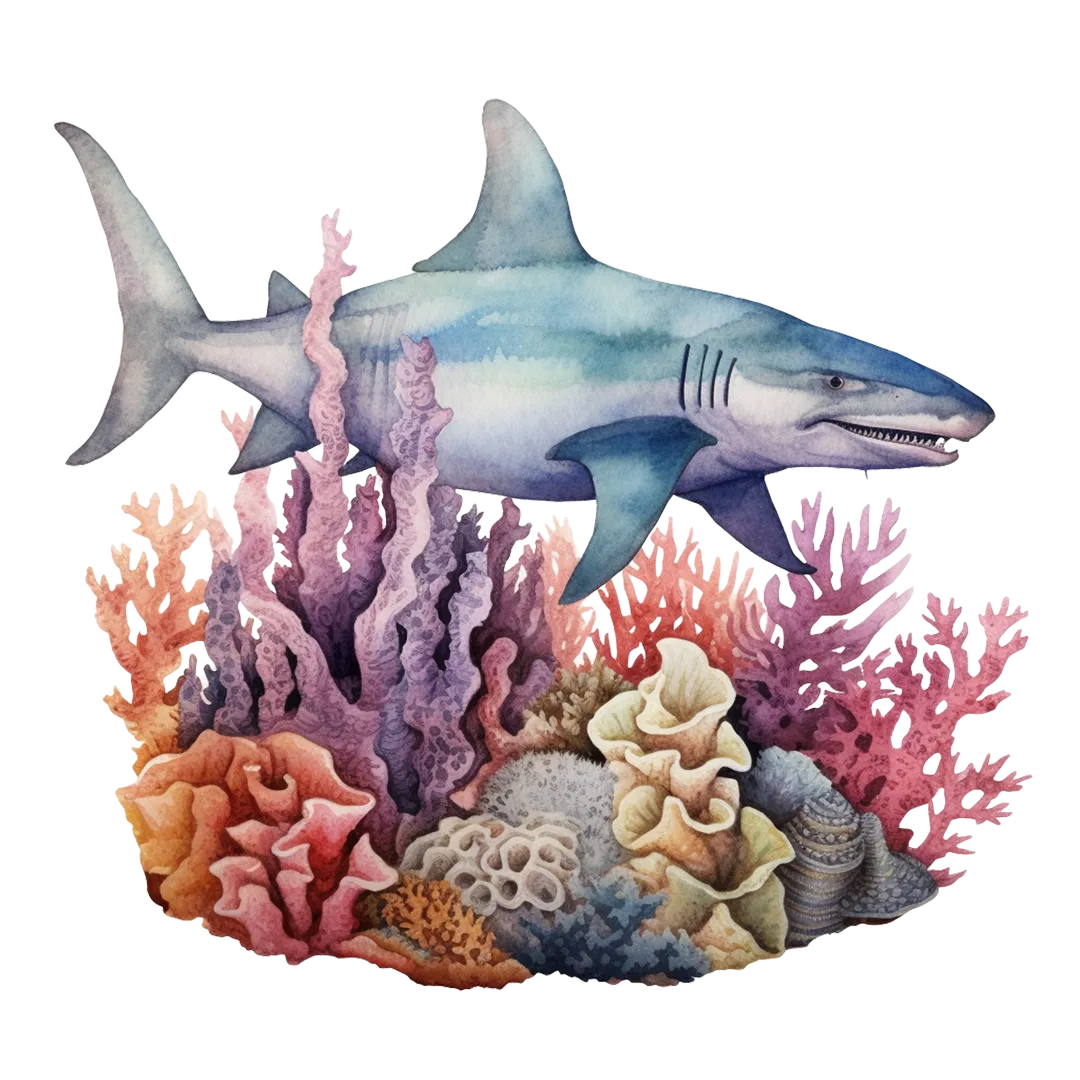 Shark Watercolor PictureLike0 likes
 Shark Watercolor PictureLike0 likes
 Shark Watercolor PictureLike0 likes
 Shark Watercolor PictureLike0 likes
 Shark Watercolor PictureLike0 likes
 Shark Watercolor PictureLike0 likes
 Shark Watercolor PictureLike0 likes
 Shark Watercolor PictureLike0 likes
 Shark Watercolor PictureLike0 likes
 Shark Watercolor PictureLike0 likes
 Shark Watercolor PictureLike0 likes
 Shark Watercolor PictureLike0 likes
 Shark Watercolor PictureLike0 likes
 Shark Watercolor PictureLike0 likes
 Shark Watercolor PictureLike0 likes
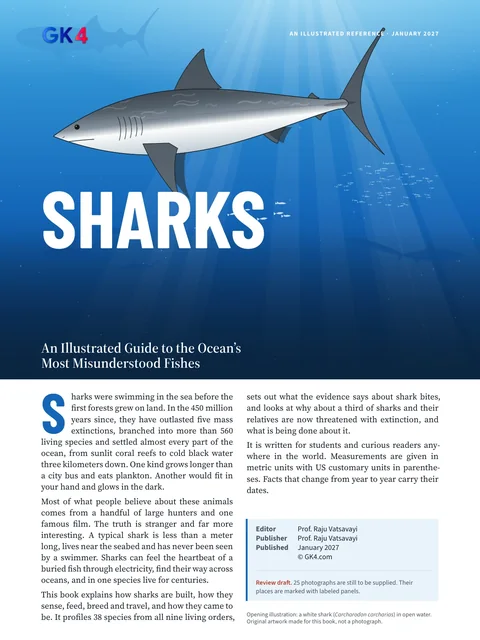
GK4 Encyclopedia Series
Shark Encyclopedia
- Editor
- Prof. Raju Vatsavayi
- Publisher
- Prof. Raju Vatsavayi
- Published
- 2027
- © GK4.com
FAQs about Sharks
50 Questions
Do sharks have bones?
No. A shark has no bones at all. Its skull, jaws, spine and fin supports are made of cartilage, the firm, flexible tissue that shapes a human nose and ears. Cartilage is about half as dense as bone, so it saves weight and lets a shark bend into tight turns. Where strength is needed, as in the jaws and the spine, the cartilage is hardened with a crust of mineral. Shark teeth and scales are not bone either. They are made of dentine with a hard enamel-like cap. Cartilage rots quickly, which is why most fossil sharks are known mainly from their teeth.
Are sharks fish or mammals?
Sharks are fish. They breathe with gills, not lungs, they have fins, and most are the same temperature as the water around them. The confusion comes from the way many sharks breed: about six in ten species give birth to live young, and in some the embryo is fed through a placenta, much as in mammals. But no shark nurses its young, and sharks are not related to whales or dolphins. Even the whale shark is a fish, the largest fish of all.
What is the biggest shark?
The whale shark, a harmless filter feeder that lives on plankton and small fishes. The longest one with a trustworthy measurement was 61.7 ft (18.8 m), which also makes it the largest fish of any kind. The basking shark, another plankton feeder, is second: the longest on record was 40.3 ft (12.27 m). The largest shark that hunts big prey is the great white shark. It reaches about 20 ft (6 m), and claims of longer ones have not held up when checked. The Greenland shark grows a little longer, to at least 21 ft (6.4 m), but it weighs far less. The biggest shark that ever lived was megalodon, which died out about 3.6 million years ago.
How big was megalodon, and is it still alive?
Megalodon is extinct. It appeared about 20 million years ago, and its youngest fossils are about 3.6 million years old. It is known mainly from teeth, which can be more than 6.7 in (17 cm) tall, and from a few sets of vertebrae, so its size has to be worked out by comparison with living sharks. Estimates of how long the largest grew run from about 49 ft (15 m) to 80 ft (24.3 m). The most complete backbone, found in Belgium, came from an animal about 54 ft (16.4 m) long, and the top estimate, 80 ft, is for the animal that left the largest vertebrae known. Nothing suggests that it survives. A whale hunter of that size would leave fresh teeth, bitten carcasses and sightings, and none has ever been found. The deep sea, where it is sometimes said to hide, is cold and holds too little food for it.
How many teeth does a shark have, and do they grow back?
It depends on the species, from a few dozen working teeth to about 3,000 tiny ones in a whale shark. And yes, they grow back, for the whole of a shark’s life. Shark teeth sit in the gum, not in sockets in the jaw. Behind each working tooth lies a row of replacements, and when a tooth breaks or wears out the next one moves up into its place. Young lemon sharks replace a row in little more than a week. Other sharks take weeks or months. A large shark may use tens of thousands of teeth in its lifetime, which is why shark teeth are among the most common fossils of animals with backbones.
Do sharks sleep?
Yes, at least some do. In 2022 scientists measured the oxygen used by draughtsboard sharks, a small bottom-living species from New Zealand. Once a shark had been still for more than five minutes, its use of oxygen fell sharply, its body sank flat against the bottom and it took a stronger stimulus to rouse it. These are the marks of sleep, and the sharks often slept with their eyes open. Many other sharks rest by day in caves or under ledges. How the sharks that must swim to breathe manage to rest is still unknown.
Do sharks lay eggs or give birth to live young?
Both. About four in ten species lay eggs, each sealed in a tough, leathery case that the mother leaves in a safe place on the seabed. The rest give birth to live young. Before birth those embryos are fed in one of three ways: by their own yolk, by a supply of extra eggs from the mother, or through a placenta, much as in mammals. A litter may be a single pup, as in the gulper shark, or about 300, as in the one pregnant whale shark ever examined. No shark is known to care for its young after birth.
What do sharks eat?
Mostly fish. For most species the menu is small bony fishes, with squid, octopus, crabs, shrimps and shellfish making up the rest. Larger sharks add larger prey: rays, other sharks, sea turtles, seabirds, seals and dolphins. The three sharks with the largest mouths, the whale shark, the basking shark and the megamouth shark, filter plankton and small fishes from the water. One small hammerhead, the bonnethead, also digests seagrass. Sharks eat less than most people think. A typical shark takes one to three percent of its body weight a day, and many go days between meals.
How long do sharks live?
From about 7 years to at least 272, depending on the species. Many sharks live 20 to 40 years. The Australian sharpnose shark, a small coastal shark of northern Australia, lives only about 7. Blue sharks reach about 20 years, spiny dogfish and sand tiger sharks about 40, and a great white shark has been aged at 73. The Greenland shark of the Arctic is the longest-lived animal with a backbone that is known. The oldest one studied was dated at about 392 years, give or take 120, so it was at least 272 years old, and females first breed at about 150. Sharks grow slowly and breed late, which is why their numbers recover slowly after heavy fishing.
How long have sharks existed? Are they older than dinosaurs and trees?
Sharks are older than both. The oldest scales that may come from sharks are about 450 million years old, and clear shark-like teeth are about 410 million years old. The first forests spread about 385 million years ago, and the first dinosaurs appeared about 230 million years ago, so sharks are nearly twice as old as the dinosaurs. They have come through all five mass extinctions. The sharks alive today belong to a group that arose in the Triassic and spread during the Jurassic. The oldest living order, the cow sharks, goes back about 195 million years.
How many people are bitten by sharks each year?
About 60 to 70 in a typical year. That is the number of unprovoked bites the International Shark Attack File confirms worldwide, among the billions of visits people make to the sea. On average, sharks kill fewer than ten people a year. Most bites happen in the United States and Australia, which have long warm coasts and many swimmers and surfers. For comparison, about 300,000 people drown each year.
Which sharks are most dangerous to people?
Three large species account for most serious bites: the great white shark, the tiger shark and the bull shark. The International Shark Attack File has linked great white sharks to more than 350 unprovoked bites over its whole history, tiger sharks to more than 140 and bull sharks to about 120. All three are big, live near coasts and have teeth suited to large prey. About a dozen of the 565 species are known to have killed a person. The great majority of sharks pose no danger, and about half of all species are less than 3.3 ft (1 m) long.
Why do sharks bite people?
People are not natural prey for any shark. Most bites are single quick bites in murky or broken water, after which the shark lets go and leaves. They are thought to be mistakes, made when a shark hunting fish snaps at a flashing hand or foot: about 60 percent of unprovoked bites happened in water with low visibility. Bites by large sharks on surfers may be cases of mistaken identity, because from below a surfer on a board has much the same outline as a seal. Sharks also test unfamiliar objects with their mouths, and a shark that is stepped on, cornered or grabbed bites to defend itself.
Do sharks have to keep swimming to stay alive?
Only some. A few dozen species, including great white sharks, makos and whale sharks, cannot pump water over their gills and must swim to breathe. Most sharks can pump water with the muscles of the cheeks and throat. Nurse sharks, catsharks, wobbegongs, angelsharks and many others spend much of their lives lying still on the seabed. Swimming also keeps a shark up. Sharks have no swim bladder, so most of them sink slowly when they stop.
How many species of shark are there?
There are 565 recognized living species, in nine orders and 38 families. The number rises almost every year as new species are described, mostly from deep water or from museum collections. More than a quarter of all known sharks, rays and chimaeras have been named since the year 2000. More than half of all sharks belong to one order, the ground sharks. The rays (696 species) are the closest relatives of sharks, and the chimaeras (58) are more distant cousins. That makes 1,319 cartilaginous fishes in all.
What is the fastest shark?
The shortfin mako is widely called the fastest shark, but its top speed has never been measured. The figures of 70 km/h (43 mph) that are often quoted are estimates. The fastest burst recorded by instruments on free-swimming makos is about 18 km/h (11 mph), from a study of two sharks, and makos can certainly go faster than that when they chase prey or leap. Ordinary cruising is slow in all sharks: 2 to 4 km/h (1 to 2.5 mph), no faster than a person walking.
What is the smallest shark?
The dwarf lanternshark, a deep-water species from the Caribbean coast of South America, which is fully grown at about 8 in (20 cm). The spined pygmy shark and a few other lanternsharks are almost as small. Small sharks are the rule, not the exception: about half of all shark species never grow longer than 3.3 ft (1 m).
Can sharks really smell blood from miles away?
No. Tests show that sharks detect some chemicals at about one part in a billion, roughly a drop in a backyard swimming pool, which is much like other fishes. A scent also travels only as far and as fast as the current carries it, in a thin, patchy trail. A shark down-current of a wounded fish may pick up the trail hundreds of meters away and follow it by comparing its two nostrils. A shark up-current will notice nothing. Sound, not smell, is often the first sense to alert a shark.
Are sharks endangered?
Many are. A full assessment of all 1,199 species of sharks, rays and chimaeras then known found 391 of them, about a third, threatened with extinction. Overfishing threatens every one of them. Oceanic sharks and rays have fallen by 71 percent since 1970, and the five commonest reef sharks have declined by an average of 63 percent. The damage is uneven. Many small deep-water species remain common, and sharks have begun to recover in places where catches are limited and the limits are enforced.
Are sharks cold-blooded?
Most are: their bodies are the same temperature as the water around them. A few are warm-bodied. The great white shark, the makos, the porbeagle, the salmon shark and at least one thresher keep their swimming muscles, stomach, eyes and brain warmer than the sea. They do it with a mesh of blood vessels in which warm blood leaving the muscles passes its heat to cold blood arriving from the gills. The stomach of a great white shark has been measured at about 14 °C (25 °F) above the water. In 2023 the basking shark, a slow plankton feeder, was found to run slightly warm too.
What eats sharks?
Other sharks, above all. Bigger sharks eat smaller ones, which is why young sharks grow up in sheltered nurseries. Seals, sea lions and large fishes also take small sharks. Large adult sharks have one natural enemy: orcas, which kill even great white sharks and often eat only the oil-rich liver. Off South Africa, the bodies of eight great white sharks killed by two orcas were found between 2017 and 2022. By far the greatest predator of sharks is people: fishing kills about 80 million sharks a year.
Can sharks live in fresh water?
A few can. The bull shark travels far up rivers, about 4,000 km (2,500 miles) up the Amazon and far up the Mississippi and the Zambezi, and it lives in Lake Nicaragua. It copes by cutting the urea in its blood by about half and passing large amounts of very dilute urine. A handful of rare river sharks in South Asia, Borneo, New Guinea and northern Australia also live in fresh water. Most sharks cannot leave the sea, because in a river their salty tissues would soak up water without limit.
Can sharks see color?
Probably not. A study of 17 species found that most have only one type of cone, the cells that serve color vision, and some have none. An animal needs at least two types to tell colors apart, so sharks are likely to see in shades of light and dark. Sharks are not blind, though. Their eyes work very well in dim light, thanks to a mirror-like layer behind the retina that gives light a second pass. The same layer makes a cat’s eyes shine in headlights.
What is a shark?
A shark is a fish with a skeleton of cartilage instead of bone. It has five to seven open gill slits on each side of its head, skin covered in tiny tooth-like scales, teeth that are replaced throughout life and no swim bladder. Its closest relatives are the rays, which are flattened and have their gill slits on the underside. There are 565 known living species, from the 8 in (20 cm) dwarf lanternshark to the 61.7 ft (18.8 m) whale shark, and about half of them are less than 3.3 ft (1 m) long.
How many sharks are killed each year?
About 80 million. That is the best estimate of the sharks that fishing kills in a year. About 25 million of them belong to threatened species. The figure counts sharks caught on purpose, sharks caught by accident by boats fishing for other species, and sharks that die after they are thrown back. The total rose during a decade in which bans on finning spread around the world, because the demand for shark meat grew.
Why are sharks important?
Sharks are predators and scavengers at many levels of the sea’s food webs. They remove sick and weak animals and hold down the numbers of their prey. They also change where other animals feed. In Shark Bay in Western Australia, sea turtles and dugongs keep away from the richest seagrass meadows when tiger sharks are present, which protects the seagrass. Sharks move nutrients between the open sea, the reefs and deep water, and they support fisheries and tourism. Their effects differ from place to place and are still being measured.
Are sharks intelligent?
Sharks learn quickly and remember for months. In experiments, young sharks have learned to press targets, find their way through mazes and tell shapes apart, and sharks that watched a trained companion learned a task faster than sharks that worked alone. Individuals differ in boldness, and some sharks keep the same companions for years. For their body size, many sharks have brains as large as those of birds and some mammals. The largest brains belong to the active, social sharks of reefs and open water.
Why is shark skin rough?
Shark skin is covered in dermal denticles, tiny scales built like teeth, with points that face the tail. Stroked from head to tail the skin feels smooth. Stroked the other way it rasps like sandpaper. The denticles protect the shark from scrapes, bites and parasites, reduce drag and make it quieter as it swims. Engineers have copied them: films pressed with similar tiny grooves trim the fuel use of airliners by around one percent.
What should I do if I see a shark while swimming?
Stay calm and keep your eyes on the shark. Move smoothly toward the shore or a boat without splashing, and stay with other people. Do not try to touch it. In the very rare event of a bite, fight back and strike the eyes and gills. If someone is bitten, get them out of the water, call the emergency services and press hard on the wound to slow the bleeding.
How can I lower the risk of a shark bite?
The risk is very small to begin with, and a few habits make it smaller. Swim, surf and dive with other people, and stay close to shore. Avoid the water at dawn, dusk and night. Keep out of murky water, river mouths and channels, especially after heavy rain. Stay away from people fishing, from schools of bait fish and from diving seabirds. Do not wear shiny jewelry, which can flash like fish scales. Avoid splashing, and follow local warnings. Do not rely on dolphins, because they hunt the same fish as sharks.
How long are sharks pregnant?
From 4.5 months to 2 years in the species that have been measured. The bonnethead has the shortest pregnancy known in a shark, 4.5 to 5 months. Blue sharks and sand tiger sharks carry their young for 9 to 12 months, and the shortfin mako for 15 to 18. The spiny dogfish is pregnant for 18 to 24 months, one of the longest confirmed pregnancies of any animal with a backbone. The frilled shark may be pregnant for about three and a half years, but that figure is an estimate from the growth of its embryos. For the great white shark and the whale shark the length of pregnancy is still not known.
What is the difference between a shark and a ray?
Rays are flattened relatives of sharks. A ray’s gill slits are on its underside, and its pectoral fins are fused to its head to form a disc. A shark’s gill slits are on the sides of its head, and its pectoral fins are free. That test settles the look-alikes: sawfishes and guitarfishes are rays, while sawsharks and angelsharks are sharks. Both groups have skeletons of cartilage, and a manta ray is a closer relative of a great white shark than either is to a salmon.
Why do hammerhead sharks have hammer-shaped heads?
The wide head is a platform for the senses. It sets the eyes, the nostrils and the electric pores far apart, which widens the field of view and helps the shark pinpoint smells and prey buried in the sand. Hammerheads sweep their heads over the seabed like metal detectors. The head may also help with tight turns, and great hammerheads use it to pin stingrays to the bottom.
How deep can sharks go?
The deepest reliable record is a Portuguese dogfish at 3,700 m (12,100 ft). Sharks are very scarce below about 3,000 m (9,800 ft), probably because the deep sea holds too little food for an animal that needs a large, oily liver to stay afloat. About half of all shark species live in deep water, mostly between 200 and 2,000 m (650 and 6,600 ft). Sharks of the surface dive deep too: whale sharks go beyond 1,900 m (6,200 ft), and scalloped hammerheads dive past 800 m (2,600 ft), holding their breath to stay warm.
Do sharks get cancer? Can shark cartilage cure it?
Sharks do get cancer. Tumors, including cancers, have been recorded in dozens of species of sharks and rays, among them the great white shark. The belief that they do not was spread in the 1990s by books that promoted shark cartilage as a cancer treatment. Careful clinical trials found that cartilage supplements did nothing for patients. Shark cartilage has no proven medical value.
What is shark finning?
Finning means cutting the fins off a shark and throwing the rest of the animal back into the sea, often while it is still alive. The fins are the most valuable part by weight and are used for shark fin soup. Many fishing nations and all the international bodies that manage tuna fisheries now ban it, and the strictest rules require sharks to be landed with their fins attached. A ban on finning is not a ban on fishing. Catching whole sharks remains legal in most places, and the trade in shark meat is now worth more than the trade in fins.
Is shark meat safe to eat?
Shark meat is eaten in many countries, but it carries a health warning. Large sharks live long and feed high in the food chain, so mercury builds up in their flesh. In the United States, the food and environment agencies list shark among the few fish to avoid altogether for anyone who is or may become pregnant, for nursing mothers and for young children. Shark is also sold under other names, such as flake, rock salmon, huss and cazón, and buying it can support the fishing of threatened species.
Do sharks glow in the dark?
More than one in ten shark species makes its own light. Nearly all are small deep-water sharks: the lanternsharks, the kitefin sharks and their relatives. Thousands of tiny light organs on the belly give off a blue glow that matches the faint light from above, so the shark shows no dark outline to a hunter below. The kitefin shark, which grows to about 6 ft (1.8 m), is the largest glowing animal with a backbone that is known. A few sharks, such as swell sharks, glow green in a different way, by taking in the blue light of the sea and giving it back as green.
How do sharks sense electricity?
Through hundreds of jelly-filled pores on the snout, called the ampullae of Lorenzini. Every living animal gives off weak electric fields as its muscles and nerves work, and the pores detect them. Sharks respond to fields as weak as five billionths of a volt per centimeter, among the most sensitive electrical detection known in any animal. The sense works within about half a meter (20 in). It guides the last moment of a strike, when the eyes are covered, and it finds prey buried under sand. Sharks only detect electricity. They cannot give a shock.
How far do sharks migrate?
Some cross whole oceans. A whale shark was tracked for 20,142 km (12,516 miles) across the Pacific, from Panama to the region of the Mariana Trench. A great white shark swam from South Africa to Australia and back, about 20,000 km (12,400 miles), in under nine months. A basking shark crossed the Atlantic from the Isle of Man to Newfoundland. Many sharks return to the same feeding and breeding places year after year, and female lemon sharks come back to give birth in the lagoon where they were born.
Do sharks make sounds?
Almost none do. Sharks have no vocal cords and no swim bladder to make sounds with, and for a long time they were thought to be silent. In 2025 researchers in New Zealand reported that a small coastal shark, the rig, makes sharp clicking sounds when it is handled under water, probably by snapping its flat teeth together. All ten sharks tested made clicks. It is the first clear evidence of a shark actively making sound. Sharks otherwise signal with posture and movement.
Can sharks walk on land?
A few can cross it briefly. Epaulette sharks and their relatives in northern Australia and New Guinea, known as walking sharks, crawl over exposed reef between tide pools on their paddle-shaped fins, and they survive for hours on very little oxygen. They still breathe with gills and must return to the water, so they are not land animals. Walking sharks are among the youngest of all sharks. The group arose within about the past nine million years.
Can a female shark have young without a male?
Yes, occasionally. Females of several species kept in aquariums without males, among them bonnethead, blacktip, bamboo and zebra sharks, have produced pups from unfertilized eggs. The process is called parthenogenesis, and DNA tests have confirmed that such pups have no father. The young are always female and have little genetic variety. It has not been proved in wild sharks, though it has been found in a wild sawfish, which is a ray. Female sharks can also store sperm for months after mating.
Do any sharks eat plants?
One does. The bonnethead, a small hammerhead of American coasts, swallows a great deal of seagrass while it hunts crabs. In feeding trials published in 2018, sharks kept on a diet that was 90 percent seagrass gained weight, digested about half of the plant material and built it into their own bodies. The bonnethead is the first shark known to be an omnivore.
How are sharks protected, and how can I help?
The main tools are catch limits based on science, bans on finning, protected areas, shark sanctuaries and controls on international trade. Seventeen countries and territories have declared their waters shark sanctuaries, beginning with Palau in 2009, and trade rules were strengthened for more than 70 species in 2025. Where catches are limited and the limits enforced, sharks have recovered. You can help by choosing sustainable seafood or avoiding shark, by checking cosmetics and supplements for shark liver oil (squalene), by picking tourism operators that follow a code of conduct and by sharing accurate information.
How do scientists track sharks?
With tags. Acoustic tags give out coded clicks that receivers on the seabed pick up when the shark swims within a few hundred meters. Satellite tags on the dorsal fin report a position each time the fin breaks the surface. Pop-up tags record depth, temperature and light for months, then cut themselves free, float up and transmit. Simple numbered tags, reported by whoever catches the shark again, first showed that blue sharks cross the Atlantic. To count sharks, scientists use baited cameras, photographs of individual markings, drones and traces of DNA in seawater.
How do scientists tell how old a shark is?
Mostly by counting growth bands in the vertebrae, which are laid down a little like the rings of a tree. The counts are checked against chemical markers, above all the radioactive carbon that the nuclear tests of the 1950s and 1960s left in every animal alive at the time. That check showed that band counts miss years in old sharks: a great white shark aged this way was 73, more than three times the earlier estimate. Greenland sharks have vertebrae too soft to show bands, so they are dated from the core of the eye lens, which forms before birth.
Can sharks find their way by the Earth’s magnetic field?
At least one species can. In an experiment published in 2021, young bonnethead sharks were placed in a tank where coils copied the magnetic field of a place far to the south of their home. They turned to swim north, as if they had read their position from a map. In a field that matched their home waters they showed no preferred direction. How sharks sense the field is not known, and few species have been tested. Such a sense would explain how sharks cross open ocean and arrive at the same reef or bay year after year.
What is a mermaid’s purse?
It is the egg case of a shark or skate, often found empty on a beach. The leathery pouch held one embryo and its yolk for months, in some species for more than a year. Catshark cases are flat pouches with curling tendrils at the corners that snag on seaweed, skate cases have horns, and bullhead sharks make a spiral case like the tip of a drill. A case with an embryo inside is alive. If you find one in the water, leave it there.
Are there eight orders of sharks or nine?
Nine, in current catalogs. Older lists give eight, because they place the two bramble sharks among the dogfishes. Studies of DNA show the bramble sharks to be a branch of their own, so they now have an order to themselves. The animals are the same and only the filing has changed. The nine orders hold very different numbers of species: more than half of all sharks are ground sharks, a quarter are dogfishes, and four orders have ten species or fewer.
General Knowledge
GK4 Yearbook India GK for all competitive exams
World Encyclopedia
GK4 Encyclopedia World GK

We Value Your Opinion Comments