
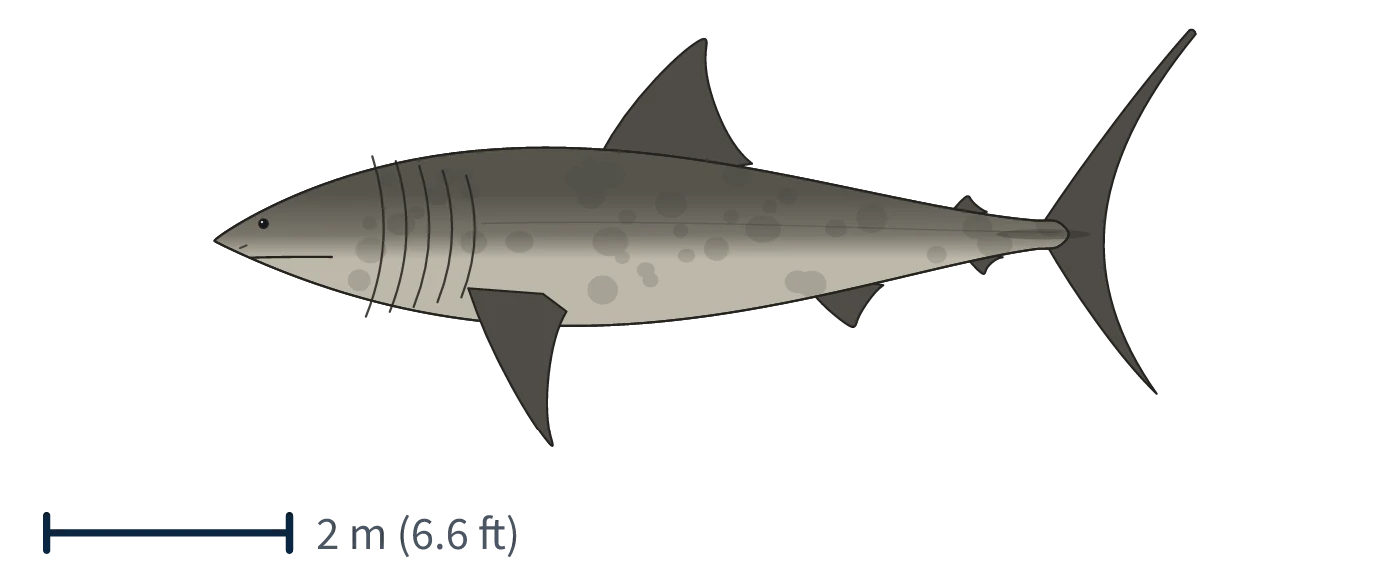
Quick facts
- Size
- Up to about 40 ft (12 m)
- Range
- Cool temperate seas of both hemispheres
- Habitat
- Coasts and open ocean; at the surface in summer, deeper in winter
- Diet
- Animal plankton, especially tiny crustaceans
- Young
- Live birth; a single litter of 6 has been recorded
- Red List class
- Endangered
- Order
- Mackerel sharks (Lamniformes)
- Family
- Cetorhinidae
- Scientific name
- Cetorhinus maximus
About the basking shark
The second-largest fish. It cruises just under the surface with its mouth open about 3 ft (nearly 1 m) wide, while bristles on its gills comb plankton from the water. Its gill slits almost circle the head. It was once thought to hibernate in winter, but tags have shown that it moves to deep water and can cross ocean basins. Hunted for centuries for its liver oil, it is now protected in much of its range.
The basking shark belongs to the mackerel sharks, one of the nine living orders of sharks. All About Sharks tells the story of sharks as a whole and names the 39 that have a page here.
More about the basking shark
In a basking shark the liver may be a quarter of the animal’s weight.
In 2023 researchers reported that the basking shark, a slow plankton feeder, also has deep red muscle and runs slightly warmer than the sea.
Blue sharks, silky sharks, makos, threshers and oceanic whitetips are built for economy, with long fins and slim bodies. The whale shark and the basking shark follow blooms of plankton. Many oceanic sharks gather at fronts, eddies and seamounts, the same places tuna fleets look for fish. That is the root of much of their trouble.
The basking shark simply swims forward with its mouth open, a method called ram filtering.
Basking sharks, makos, threshers and great white sharks all leap clear of the water. A basking shark several meters long can leave the surface at about the same speed as a breaching great white shark.
The longest basking shark was 40.3 ft (12.27 m), recorded in 1851.
The first listings, in 2002, covered only the basking shark and the whale shark.
More mackerel sharks
 Great white sharkCarcharodon carchariasVulnerable
 Shortfin makoIsurus oxyrinchusEndangered
 PorbeagleLamna nasusVulnerable
 Salmon sharkLamna ditropisLeast Concern
 Pelagic thresherAlopias pelagicusEndangered
 Sand tiger sharkCarcharias taurusCritically Endangered
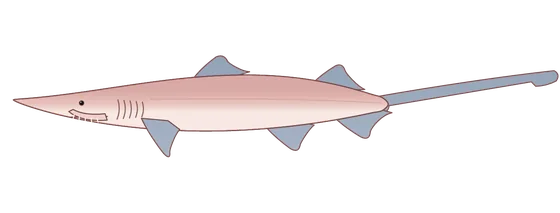 Goblin sharkMitsukurina owstoniLeast Concern
 Megamouth sharkMegachasma pelagiosLeast Concern
PreviousSalmon sharkAll About SharksAll 39 speciesNextPelagic thresher
Basking Shark Pictures
Real-Life Pictures and Realistic Watercolor Images
3 Pictures


FAQs about the Basking Shark
6 Questions
How big is the basking shark?
Up to about 40 ft (12 m).
Where does the basking shark live?
Cool temperate seas of both hemispheres. Habitat: coasts and open ocean; at the surface in summer, deeper in winter.
What does the basking shark eat?
Animal plankton, especially tiny crustaceans.
How does the basking shark reproduce?
Live birth; a single litter of 6 has been recorded.
Is the basking shark threatened with extinction?
Yes. The basking shark is classed as Endangered on the IUCN Red List, which means a very high risk of extinction in the wild. Regional populations may differ, and classes are revised from time to time.
What kind of shark is the basking shark?
The basking shark (Cetorhinus maximus) belongs to the family Cetorhinidae in the order Lamniformes, the mackerel sharks. That is one of the nine living orders of sharks.
General Knowledge
GK4 Yearbook India GK for all competitive exams
World Encyclopedia
GK4 Encyclopedia World GK

We Value Your Opinion Comments