
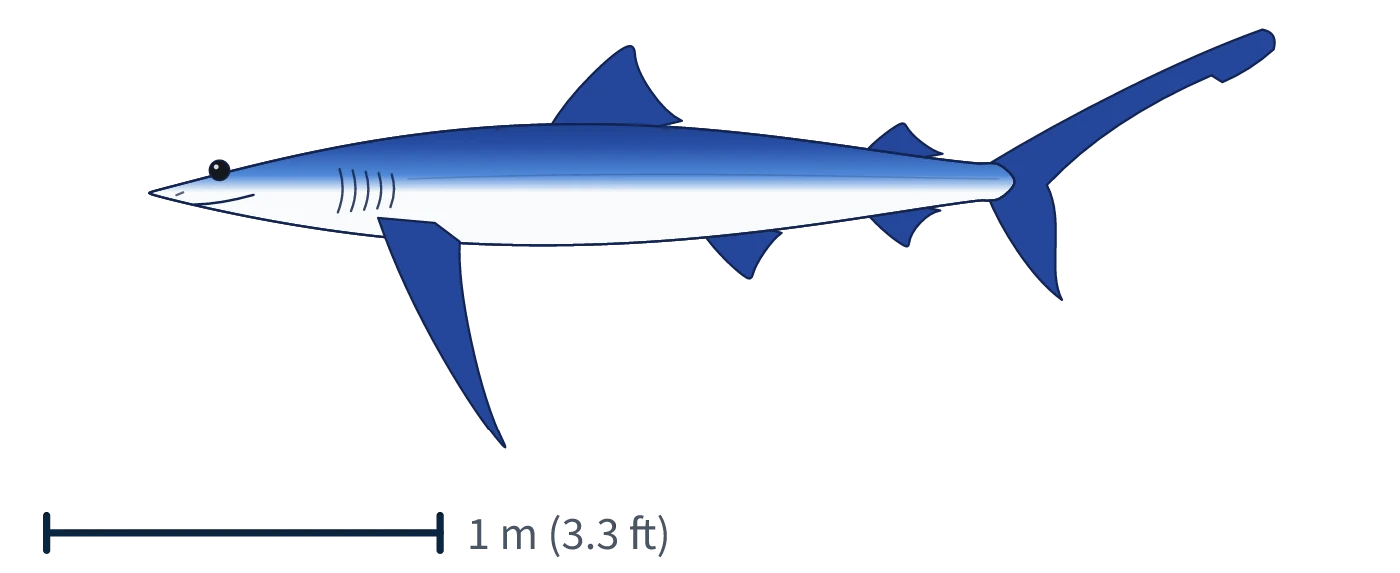
Quick facts
- Size
- Up to about 12.5 ft (3.8 m)
- Range
- Temperate and tropical oceans worldwide
- Habitat
- Open ocean, mostly in the top few hundred meters
- Diet
- Squid and small schooling fishes
- Young
- Live birth; about 35 pups on average, up to 135
- Red List class
- Near Threatened
- Order
- Ground sharks (Carcharhiniformes)
- Family
- Carcharhinidae
- Scientific name
- Prionace glauca
About the blue shark
Slender, long-finned and indigo above, the blue shark is the wanderer of the open sea. Tagged animals have crossed the Atlantic, riding the currents in a great circuit. It is also the most heavily fished shark in the world. Millions are caught each year, mostly on longlines set for tuna and swordfish, and its fins are the most common in the fin trade. Large litters make it more resilient than most sharks, though not limitlessly so.
The blue shark belongs to the ground sharks, one of the nine living orders of sharks. All About Sharks tells the story of sharks as a whole and names the 39 that have a page here.
More about the blue shark
The male typically seizes the female’s pectoral fin or flank in his teeth to hold his position, and mature females often carry the scars. In some species, such as the blue shark, the skin of females is much thicker than that of males.
In many ground sharks, including bull sharks, blue sharks and hammerheads, the empty yolk sac attaches to the wall of the womb and becomes a placenta.
Blue sharks, silky sharks, makos, threshers and oceanic whitetips are built for economy, with long fins and slim bodies.
Male and female blue sharks use different parts of the ocean for much of the year.
Adult males and females of blue sharks, spiny dogfish and several others live apart for most of the year and meet only to mate.
Longlines set for tuna and swordfish, with thousands of baited hooks on lines tens of kilometers long, catch blue sharks, makos, threshers and oceanic whitetips.
Young great white sharks have appeared in bays north of their former range off California, and bull sharks are using estuaries farther from the tropics. Warmer water also holds less oxygen, which squeezes active sharks such as the blue shark and the mako into a thinner surface layer, where they are easier to catch.
A program run by the United States government since 1962, with the help of thousands of volunteer anglers, has tagged more than a quarter of a million sharks in this way. It first revealed that blue sharks cross the Atlantic.
More ground sharks
 Tiger sharkGaleocerdo cuvierNear Threatened
 Bull sharkCarcharhinus leucasVulnerable
 Speartooth sharkGlyphis glyphisVulnerable
 Oceanic whitetip sharkCarcharhinus longimanusCritically Endangered
 Great hammerheadSphyrna mokarranCritically Endangered
 Scalloped hammerheadSphyrna lewiniCritically Endangered
 BonnetheadSphyrna tiburoEndangered
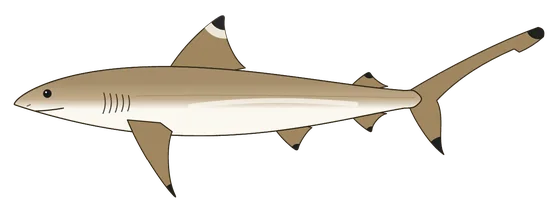 Blacktip reef sharkCarcharhinus melanopterusVulnerable
PreviousSpeartooth sharkAll About SharksAll 39 speciesNextOceanic whitetip shark
Blue Shark Pictures
Real-Life Pictures and Realistic Watercolor Images
3 Pictures


FAQs about the Blue Shark
6 Questions
How big is the blue shark?
Up to about 12.5 ft (3.8 m).
Where does the blue shark live?
Temperate and tropical oceans worldwide. Habitat: open ocean, mostly in the top few hundred meters.
What does the blue shark eat?
Squid and small schooling fishes.
How does the blue shark reproduce?
Live birth; about 35 pups on average, up to 135.
Is the blue shark threatened with extinction?
No. The blue shark is classed as Near Threatened on the IUCN Red List, which means it is close to qualifying as threatened. Regional populations may differ, and classes are revised from time to time.
What kind of shark is the blue shark?
The blue shark (Prionace glauca) belongs to the family Carcharhinidae in the order Carcharhiniformes, the ground sharks. That is one of the nine living orders of sharks.
General Knowledge
GK4 Yearbook India GK for all competitive exams
World Encyclopedia
GK4 Encyclopedia World GK

We Value Your Opinion Comments