
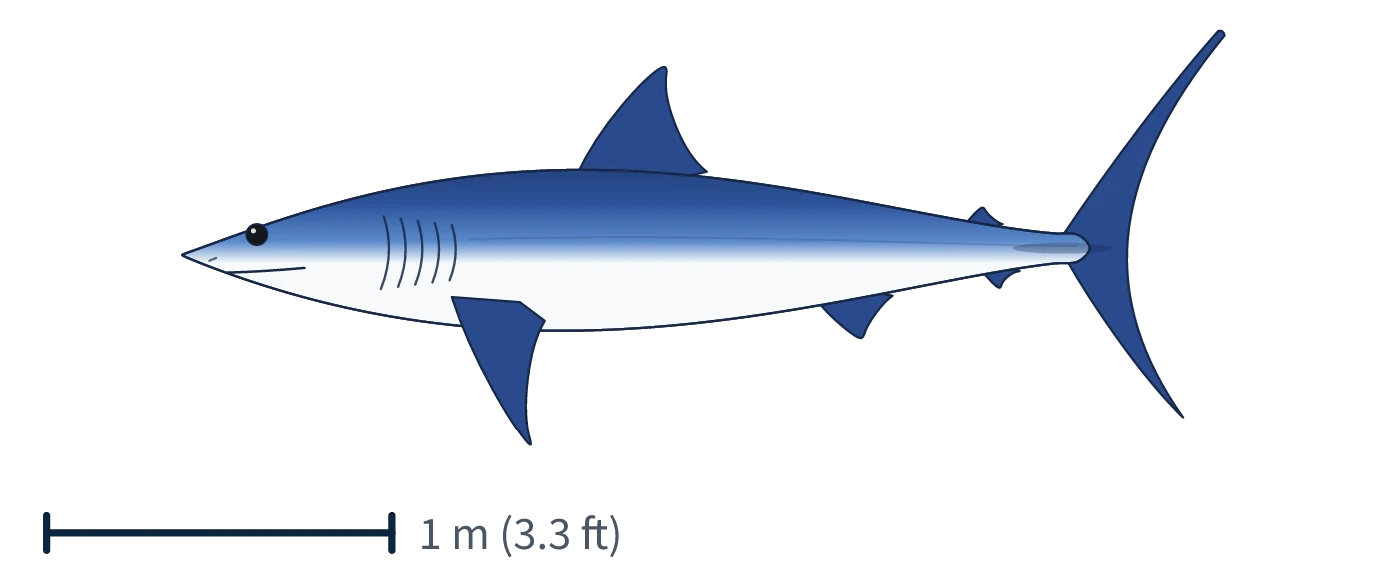
Quick facts
- Size
- Up to about 13 ft (4 m)
- Range
- Temperate and tropical oceans worldwide
- Habitat
- Open ocean, mostly in the top 500 m (1,650 ft)
- Diet
- Tunas, mackerels, swordfish, squid and other sharks
- Young
- Live birth; about 11 pups on average, every three years
- Red List class
- Endangered
- Order
- Mackerel sharks (Lamniformes)
- Family
- Lamnidae
- Scientific name
- Isurus oxyrinchus
About the shortfin mako
Built like a tuna, with a pointed snout, a crescent tail and warm swimming muscles, the mako is widely regarded as the fastest shark and is known for spectacular leaps. Its slim, hooked teeth show even when the mouth is closed. Females in the North Atlantic do not breed until about 18. Heavy catches on longlines led to a ban on keeping North Atlantic makos, agreed in 2021.
The shortfin mako belongs to the mackerel sharks, one of the nine living orders of sharks. All About Sharks tells the story of sharks as a whole and names the 39 that have a page here.
More about the shortfin mako
Most sharks swim by passing a wave down the rear half of the body, as an eel does but less extreme. Mackerel sharks such as the mako and the great white shark swim more like tunas. They hold the body almost rigid and beat only the tail stalk and tail, a method that wastes little energy at speed.
The shortfin mako is widely called the fastest shark, and figures of 70 km/h (43 mph) or more are often quoted, but they are estimates.
Speeds of 50 to 74 km/h (31 to 46 mph) are widely quoted for the shortfin mako, but they come from estimates, not instruments. The fastest burst so far recorded by a tag on a free-swimming mako is about 18 km/h (11 mph). The mako may well be the fastest shark. The honest answer to how fast is that we do not yet know.
Young great white sharks have appeared in bays north of their former range off California, and bull sharks are using estuaries farther from the tropics. Warmer water also holds less oxygen, which squeezes active sharks such as the blue shark and the mako into a thinner surface layer, where they are easier to catch.
Tags are expensive, so samples are small: the measured top speed of the mako comes from two animals.
More mackerel sharks
 Great white sharkCarcharodon carchariasVulnerable
 PorbeagleLamna nasusVulnerable
 Salmon sharkLamna ditropisLeast Concern
 Basking sharkCetorhinus maximusEndangered
 Pelagic thresherAlopias pelagicusEndangered
 Sand tiger sharkCarcharias taurusCritically Endangered
 Goblin sharkMitsukurina owstoniLeast Concern
 Megamouth sharkMegachasma pelagiosLeast Concern
PreviousGreat white sharkAll About SharksAll 39 speciesNextPorbeagle
Shortfin Mako Pictures
Real-Life Pictures and Realistic Watercolor Images
5 Pictures


FAQs about the Shortfin Mako
6 Questions
How big is the shortfin mako?
Up to about 13 ft (4 m).
Where does the shortfin mako live?
Temperate and tropical oceans worldwide. Habitat: open ocean, mostly in the top 500 m (1,650 ft).
What does the shortfin mako eat?
Tunas, mackerels, swordfish, squid and other sharks.
How does the shortfin mako reproduce?
Live birth; about 11 pups on average, every three years.
Is the shortfin mako threatened with extinction?
Yes. The shortfin mako is classed as Endangered on the IUCN Red List, which means a very high risk of extinction in the wild. Regional populations may differ, and classes are revised from time to time.
What kind of shark is the shortfin mako?
The shortfin mako (Isurus oxyrinchus) belongs to the family Lamnidae in the order Lamniformes, the mackerel sharks. That is one of the nine living orders of sharks.
General Knowledge
GK4 Yearbook India GK for all competitive exams
World Encyclopedia
GK4 Encyclopedia World GK

We Value Your Opinion Comments