
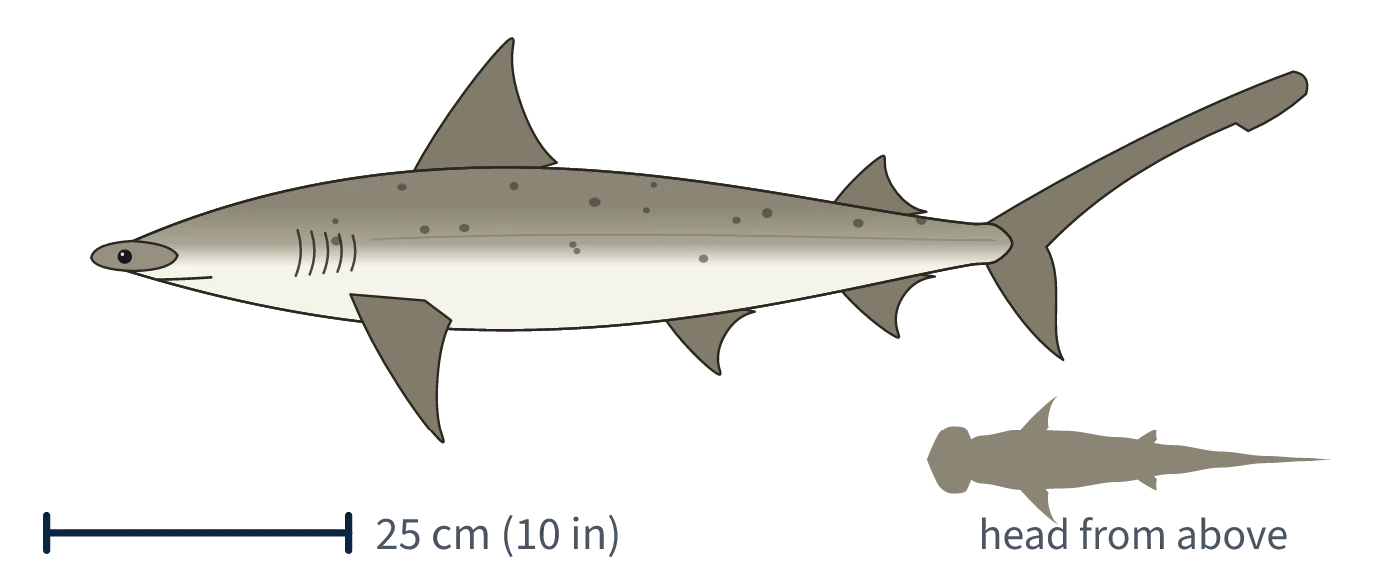
Quick facts
- Size
- Up to about 5 ft (1.5 m); usually about 3.3 ft (1 m)
- Range
- Warm coasts of the western Atlantic from the Carolinas to the Gulf of Mexico and the Bahamas; also the eastern Pacific
- Habitat
- Shallow bays, estuaries and seagrass beds, to about 80 m (260 ft)
- Diet
- Crabs, shrimps and small fishes, with a good deal of seagrass
- Young
- Live birth after only 4.5 to 5 months, the shortest pregnancy known in a shark
- Red List class
- Endangered
- Order
- Ground sharks (Carcharhiniformes)
- Family
- Sphyrnidae
- Scientific name
- Sphyrna tiburo
About the bonnethead
The smallest of the hammerheads, with a head like a rounded shovel. It has given science two surprises. In 2018 it was shown to digest the seagrass it swallows, the only shark known to feed partly on plants. In 2021 it supplied the first clear evidence that sharks navigate by the Earth’s magnetic field. Its Red List class was set before the bonnetheads of the Caribbean and Brazil were named as a separate species.
The bonnethead belongs to the ground sharks, one of the nine living orders of sharks. All About Sharks tells the story of sharks as a whole and names the 39 that have a page here.
More about the bonnethead
In 2024 the small hammerhead of the Caribbean and Brazil, long treated as a bonnethead, was shown to be a species of its own and named Sphyrna alleni, the shovelbill shark.
Researchers in Florida caught 20 young bonnethead sharks, a small hammerhead that returns to the same estuaries each year, and placed them in a tank surrounded by coils that could imitate the magnetic field of places hundreds of kilometers away.
Different species leaned on different senses: nurse sharks could not find food without smell, while blacktip and bonnethead sharks managed by sight.
In 2001 a female bonnethead shark at a zoo in Nebraska gave birth to a pup. She had not been near a male for three years.
The bonnethead, a small hammerhead of American coasts, hunts crabs in seagrass meadows, and its stomach is often full of grass.
For three weeks they fed captive bonnetheads a diet that was 90 percent seagrass, grown with a chemical label. The sharks gained weight, digested about half of the plant material and built the labeled carbon into their own tissues. The bonnethead is the first shark known to be an omnivore.
More ground sharks
 Tiger sharkGaleocerdo cuvierNear Threatened
 Bull sharkCarcharhinus leucasVulnerable
 Speartooth sharkGlyphis glyphisVulnerable
 Blue sharkPrionace glaucaNear Threatened
 Oceanic whitetip sharkCarcharhinus longimanusCritically Endangered
 Great hammerheadSphyrna mokarranCritically Endangered
 Scalloped hammerheadSphyrna lewiniCritically Endangered
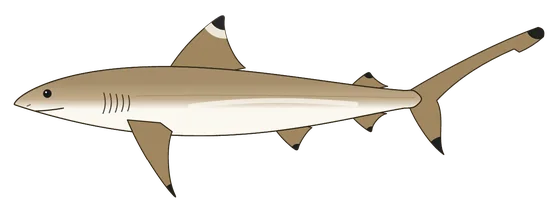 Blacktip reef sharkCarcharhinus melanopterusVulnerable
PreviousScalloped hammerheadAll About SharksAll 39 speciesNextBlacktip reef shark
FAQs about the Bonnethead
6 Questions
How big is the bonnethead?
Up to about 5 ft (1.5 m); usually about 3.3 ft (1 m).
Where does the bonnethead live?
Warm coasts of the western Atlantic from the Carolinas to the Gulf of Mexico and the Bahamas; also the eastern Pacific. Habitat: shallow bays, estuaries and seagrass beds, to about 80 m (260 ft).
What does the bonnethead eat?
Crabs, shrimps and small fishes, with a good deal of seagrass.
How does the bonnethead reproduce?
Live birth after only 4.5 to 5 months, the shortest pregnancy known in a shark.
Is the bonnethead threatened with extinction?
Yes. The bonnethead is classed as Endangered on the IUCN Red List, which means a very high risk of extinction in the wild. Regional populations may differ, and classes are revised from time to time.
What kind of shark is the bonnethead?
The bonnethead (Sphyrna tiburo) belongs to the family Sphyrnidae in the order Carcharhiniformes, the ground sharks. That is one of the nine living orders of sharks.
General Knowledge
GK4 Yearbook India GK for all competitive exams
World Encyclopedia
GK4 Encyclopedia World GK

We Value Your Opinion Comments