
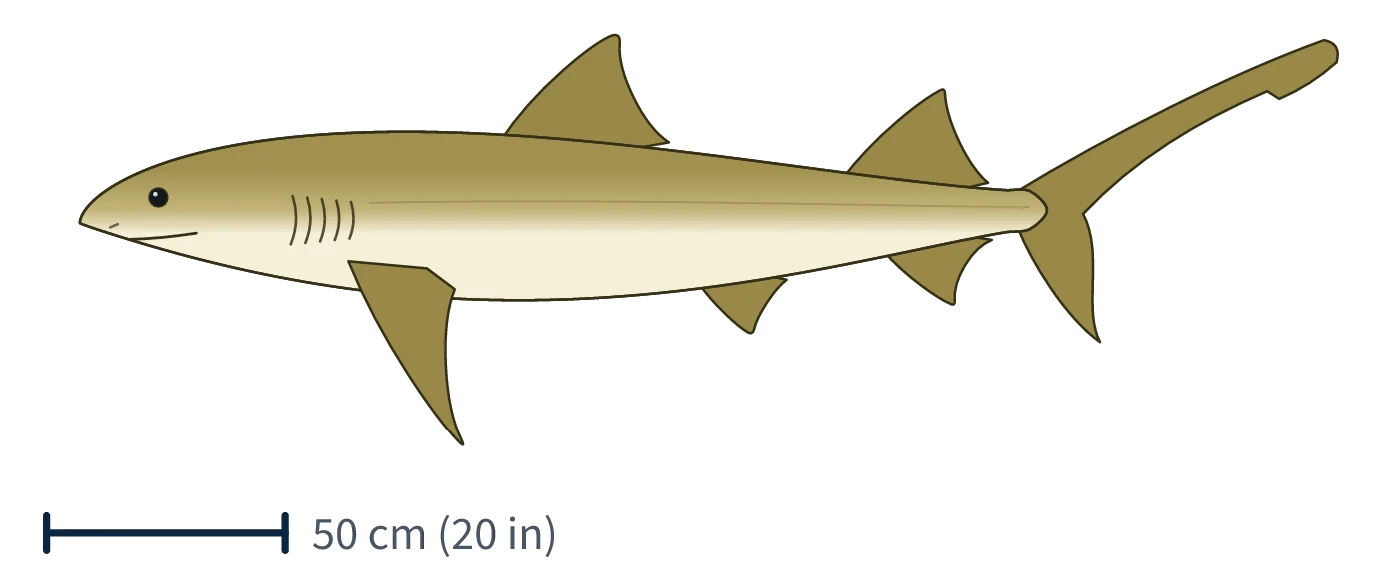
Quick facts
- Size
- Up to about 11 ft (3.4 m)
- Range
- Warm coasts of the western Atlantic, West Africa and the eastern Pacific
- Habitat
- Shallow bays, mangroves, river mouths and reefs to about 90 m (300 ft)
- Diet
- Bony fishes, rays and crabs
- Young
- Live birth; 4 to 17 pups, born in shallow nurseries
- Red List class
- Vulnerable
- Order
- Ground sharks (Carcharhiniformes)
- Family
- Carcharhinidae
- Scientific name
- Negaprion brevirostris
About the lemon shark
Probably the most thoroughly studied shark in the world, thanks to a field station at Bimini in the Bahamas where generations have been followed since the 1990s. Lemon sharks do well in captivity and learn quickly, so they have been used in experiments on vision, learning and social life. Young sharks form groups, prefer familiar companions and copy experienced animals.
The lemon shark belongs to the ground sharks, one of the nine living orders of sharks. All About Sharks tells the story of sharks as a whole and names the 39 that have a page here.
More about the lemon shark
Working from the proportions of 145 living and 20 extinct shark species, the team concluded that megalodon was more slender, closer in build to a lemon shark.
Young lemon sharks have been found to replace a row of teeth in little more than a week.
At Bimini in the Bahamas, scientists have tagged and genetically sampled almost every lemon shark born in one lagoon since 1995.
Young lemon sharks and bull sharks grow up in mangrove creeks and river mouths and move to open coasts as adults.
Young lemon sharks in the nursery at Bimini choose their company. Given a choice, they prefer to swim with sharks of their own size and with individuals they already know.
In laboratory tests young lemon sharks, bamboo sharks and Port Jackson sharks have learned to press targets, find their way through mazes and tell shapes apart, and they remember the lessons for months.
Lemon sharks that watched a trained companion solve a task learned it faster than those that had to work it out alone.
More ground sharks
 Tiger sharkGaleocerdo cuvierNear Threatened
 Bull sharkCarcharhinus leucasVulnerable
 Speartooth sharkGlyphis glyphisVulnerable
 Blue sharkPrionace glaucaNear Threatened
 Oceanic whitetip sharkCarcharhinus longimanusCritically Endangered
 Great hammerheadSphyrna mokarranCritically Endangered
 Scalloped hammerheadSphyrna lewiniCritically Endangered
 BonnetheadSphyrna tiburoEndangered
PreviousBlacktip reef sharkAll About SharksAll 39 speciesNextSmall-spotted catshark
Lemon Shark Pictures
Real-Life Pictures and Realistic Watercolor Images
2 Pictures


FAQs about the Lemon Shark
6 Questions
How big is the lemon shark?
Up to about 11 ft (3.4 m).
Where does the lemon shark live?
Warm coasts of the western Atlantic, West Africa and the eastern Pacific. Habitat: shallow bays, mangroves, river mouths and reefs to about 90 m (300 ft).
What does the lemon shark eat?
Bony fishes, rays and crabs.
How does the lemon shark reproduce?
Live birth; 4 to 17 pups, born in shallow nurseries.
Is the lemon shark threatened with extinction?
Yes. The lemon shark is classed as Vulnerable on the IUCN Red List, which means a high risk of extinction in the wild. Regional populations may differ, and classes are revised from time to time.
What kind of shark is the lemon shark?
The lemon shark (Negaprion brevirostris) belongs to the family Carcharhinidae in the order Carcharhiniformes, the ground sharks. That is one of the nine living orders of sharks.
General Knowledge
GK4 Yearbook India GK for all competitive exams
World Encyclopedia
GK4 Encyclopedia World GK

We Value Your Opinion Comments